Industrial machinery
Presses, production equipment and tall industrial assemblies requiring a lower loaded deck height.

Instant Logistics coordinates double drop trailer transportation for tall, oversized and specialized freight across Canada and the United States. The plan starts with verified cargo dimensions, weight, centre of gravity, loading method and site access—then aligns equipment, permits, route feasibility and shipment communication.
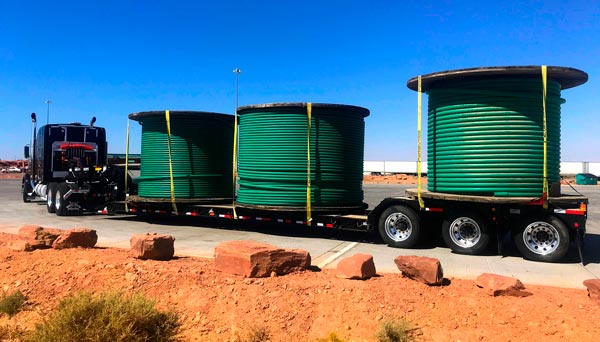
A double drop trailer is specialized open-deck equipment with an upper deck, a lowered centre well and a rear deck above the axles. The lower well can create more vertical room for eligible tall freight than a standard flatbed or step deck. Trailer dimensions, capacity, axle configuration and loading method vary, so the cargo must be matched to a confirmed equipment specification rather than a generic trailer name.
Double drop equipment is considered when cargo height, shape or loading requirements exceed what a standard open-deck trailer can support. Final suitability depends on the complete load profile, actual trailer specifications, route and jurisdictional requirements.
Presses, production equipment and tall industrial assemblies requiring a lower loaded deck height.
Eligible equipment and attachments matched to deck geometry, loading method and securement points.
Fabricated structures, frames and modules with unusual height, length or centre-of-gravity considerations.
Large reels and spools requiring verified cradling, securement, deck loading and site handling.
Eligible transformers, skids and project components subject to precise dimensions and weight distribution.
Custom-built items that need equipment selection and routing based on their exact final shipping dimensions.
A quote based only on commodity and weight can miss the details that determine whether the freight physically fits, loads safely and can travel the proposed route. Provide the complete cargo profile as early as possible.
Overall length, width and height—including packaging, cradles, protrusions and attachments.
Total weight, centre of gravity, support points and any concentrated-load information.
Crane, forklift, drive-on or other loading plan, plus available lifting points and orientation.
Pickup and delivery access, surface, turning space, gates, overhead restrictions and appointment rules.
Manufacturer guidance, approved contact points, blocking or cradling and weather-protection requirements.
Complete addresses, target dates, operating windows, border crossing and site-contact details.
Double drop shipments are planned in sequence. A change in cargo dimensions, trailer configuration or route can affect permits, scheduling, escort requirements and price, so the shipment data should remain consistent from quote through dispatch.
Verify dimensions, weight, balance, photographs, drawings and handling instructions.
Confirm well length, deck height, capacity, axle configuration and loading method.
Evaluate clearances, roadway restrictions, construction, local access and border routing.
Align permit, escort, signage, timing and jurisdictional requirements where applicable.
Confirm equipment arrival, loading access, cargo orientation, securement and departure timing.
Provide status communication and coordinate arrival, unloading and delivery documentation.
These names describe different deck profiles or loading configurations, but terminology and specifications vary by carrier and manufacturer. The correct choice comes from the cargo geometry and loading plan—not the label alone.
| Decision factor | Double drop | Step deck | RGN / lowboy |
|---|---|---|---|
| Deck profile | Upper deck, low centre well and rear deck. | Upper deck followed by one lower main deck. | Low deck with a detachable front neck on applicable configurations. |
| Typical advantage | More vertical room in the well for eligible tall cargo. | Useful lower deck with more continuous loading area for many open-deck loads. | Front-loading capability can support self-propelled equipment. |
| Loading | Fixed-neck versions commonly need crane or forklift loading; configuration must be confirmed. | Side, rear, crane or forklift loading depending on cargo and site. | Detachable neck may create a ramp for drive-on loading. |
| Confirm before use | Well length, deck height, transition clearance, capacity and axle setup. | Deck length, loaded height, ramp needs, weight distribution and securement. | Ground clearance, ramp angle, neck type, deck length and capacity. |
Some carriers and manufacturers use overlapping terminology. Always obtain the actual trailer specifications and confirm the proposed loading method before dispatch.
A double drop trailer does not automatically make an oversized or overweight shipment legal. Permit thresholds and operating conditions vary by province, state, roadway authority and local jurisdiction. The loaded vehicle dimensions, axle weights, route, travel time and support requirements must be reviewed for the actual movement.
Instant Logistics coordinates specialized open-deck freight within Canada and between Canadian and U.S. origins and destinations. The transportation plan can include equipment sourcing, shipment data review, route and permit coordination, pickup scheduling, border-ready communication, tracking and delivery updates.
Accurate cargo measurements and site information are essential. Trailer selection, permits, route feasibility and final cost can change when the load profile changes.
Provide the commodity, exact overall length, width, height and weight, centre of gravity, support points, photographs, dimensioned drawings, loading and unloading method, pickup and delivery addresses, site restrictions, target dates and securement or weather-protection requirements.
The lowered centre well can create additional vertical room for eligible tall freight compared with a standard flatbed or step deck. Actual well length, deck height, capacity and axle configuration vary and must be confirmed for the specific load.
No. Fixed-neck double drop trailers may require crane, forklift or another external loading method. A removable gooseneck configuration may create a front-loading ramp, but the actual neck design, ramp angle and cargo suitability must be confirmed.
Permit requirements depend on the complete loaded vehicle dimensions, axle weights, route and jurisdictions involved. If the movement exceeds applicable legal limits, permits and operating conditions may be required by provincial, state, local or roadway authorities.
Yes. Instant Logistics coordinates eligible double drop and specialized open-deck freight within Canada and between Canada and the United States. Capacity, permits, customs responsibilities, route feasibility and shipment requirements must be reviewed for the specific movement.
Consolidation is not automatic and is often unsuitable for oversized or highly specialized freight. It depends on deck space, cargo compatibility, route, permits, handling, securement and schedule. A dedicated movement may be the more practical option.
Tracking and communication capabilities depend on the carrier, equipment and transportation plan. State the visibility, reporting and contact requirements before booking so the available option can be confirmed.
Share the cargo drawing, overall dimensions, weight, loading method, site conditions, lane and target dates. Instant Logistics will review the information and coordinate an appropriate specialized freight option.
Prefer to speak with the team? Call +1 226-289-1414 or email Customerservice@instantlogistics.ca.