Building supply
Building materials
Eligible packaged lumber, roofing, siding and construction products delivered to a suitable placement area.

Truck-mounted forklift delivery
Coordinate eligible freight delivery with a truck-mounted forklift across Canada and the United States. The load, forklift capacity, surface, access route, clearances, pedestrian controls and placement area are reviewed before dispatch.
A practical answer
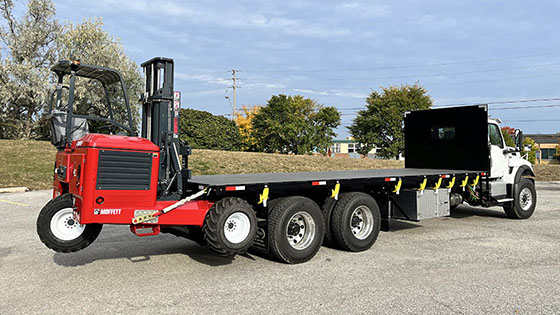
A Moffett delivery uses a truck-mounted forklift carried on the transport vehicle. At an approved site, the equipment is dismounted so the operator can unload eligible freight and move it to the confirmed placement area. It can reduce dependence on a receiving dock or customer-supplied forklift, but only when the load, equipment and worksite are suitable.
Where the service may fit
These examples are planning categories, not automatic acceptance. Final suitability depends on the exact freight, forklift configuration, trailer, site, route, weather and available capacity.
Eligible packaged lumber, roofing, siding and construction products delivered to a suitable placement area.
Freight delivered where dock access is unavailable and the operating area can be controlled.
Eligible palletized equipment, components and materials with stable packaging and defined handling points.
Eligible palletized products delivered where the surface, route and placement area can support the operation.
Eligible freight reviewed against road access, gate width, ground condition, overhead clearance and receiver instructions.
Commercial or warehouse deliveries where truck-mounted unloading is confirmed as the appropriate method.
Choose the unloading method
The freight and receiving site determine the correct method. A Moffett can solve certain dock and unloading constraints, but it adds site, load and equipment checks that must be completed before dispatch.
Moffett service does not automatically include indoor placement, installation, crane work, hand carrying, debris removal or movement across an unapproved surface. Define the delivery endpoint before quoting.
Before equipment is assigned
A Moffett quote needs the details of every planned lift and the unloading site. Photos and measurements can resolve questions that an address alone cannot answer.
Describe the exact product, pallet, bundle, crate or other handling unit.
Provide the maximum weight of each pallet, bundle or item—not only the shipment total.
State length, width, height, fork entry, load centre and known centre-of-gravity concerns.
Include complete addresses, contacts, operating hours and appointment requirements.
Describe pavement, gravel, compacted ground, slope, soft areas, curbs and transitions.
Provide gate width, turning space, overhead wires, branches, structures and path dimensions.
Define where the freight should be set down and the route from trailer to that location.
Identify pedestrians, traffic, site authorization, weather concerns and current site images.
Receiving-site readiness
Worksite conditions can change between quoting and arrival. The receiver should keep the unloading area accessible and advise the coordinator when the surface, route, weather or placement plan changes.
The travel and placement areas must support the equipment and loaded forklift without unsafe sinking or instability.
Slopes, ramps, drop-offs and transitions must be identified and acceptable for the assigned equipment.
The truck, trailer and forklift need sufficient approach, dismounting, turning and reversing room.
Gates, parked vehicles, debris, curbs, trenches and other obstructions should be addressed before arrival.
Wires, branches, canopies, doors and structures must allow the equipment and load to pass safely.
People and other vehicles should be kept outside the active unloading and travel area.
Rain, snow, ice, mud, wind and visibility can change whether unloading remains suitable.
The receiver should confirm site permission, final drop location and any property restrictions.
Delivery workflow
The workflow is designed to resolve load, equipment and site questions before the truck arrives.
Confirm commodity, packaging, dimensions, weight, balance and fork entry.
Check surface, grade, access, space, clearances, traffic and placement.
Match a suitable truck-mounted forklift, trailer and required attachments.
Align the address, appointment, contacts, instructions and communication plan.
Confirm that freight and site conditions still match the approved plan.
The operator completes the approved placement or stops if conditions are unsafe.
Capacity and safety limits
There is no universal Moffett capacity that applies to every truck-mounted forklift, attachment or load. Rated capacity, load centre, lift height, fork configuration, load stability and worksite conditions must be evaluated for the assigned equipment.
Capacity depends on the actual model, configuration, attachment, load centre and lift conditions.
Damaged pallets, shifting products, poor fork entry or an uncertain centre of gravity can prevent unloading.
Pedestrians, traffic, obstructions, edges, poor surfaces and inadequate clearances must be addressed.
The operator may pause, change or refuse unloading when the load, equipment or site is not suitable.
A quote or site photo does not override the assigned equipment limits or the operator’s on-site safety assessment.
Common questions
Start with the individual lift and the receiving site. Those two profiles determine whether truck-mounted forklift delivery is appropriate.
MOFFETT is a brand of truck-mounted forklift. The equipment attaches to a transport truck or trailer so it can travel with the freight and be used for eligible loading or unloading work at the delivery site.
It can support eligible deliveries where no dock or receiver-supplied forklift is available. The site must still provide suitable access, surface, space, clearances, traffic control and an approved placement area.
Provide the commodity, packaging, quantity, individual lift weights and dimensions, fork entry, origin, destination, appointment, surface, grade, access path, overhead clearance, turning space, placement point and current site photos.
There is no single capacity for every unit. Capacity depends on the assigned model, data plate, mast and fork configuration, attachments, load centre, lift height and operating conditions. Provide the weight and dimensions of each planned lift so suitable equipment can be reviewed.
Suitability depends on the equipment and the actual surface, compaction, grade, drainage, weather and load. Do not assume unpaved or winter surfaces are acceptable. Share current site details and photos, and keep the operator’s route firm, accessible and free of unsafe conditions.
No. The placement area and travel path must be reviewed and approved. Indoor placement, travel through gates or doors, steep grades, soft ground, overhead obstructions and long-distance site travel are not automatically included.
Only when the individual item fits the assigned forklift’s capacity, load-centre, fork, stability and site limits. A Moffett is not a substitute for a crane or every specialized-rigging requirement.
The operator evaluates the freight, equipment and site conditions at delivery. Unloading may be paused, changed or refused if the load is unstable, the surface or clearances are unsuitable, pedestrians cannot be controlled or other unsafe conditions exist.
No blanket same-day guarantee is stated. Availability depends on the lane, freight, site, timing, equipment configuration, operator and current capacity. Any delivery commitment should be confirmed for the specific shipment.
Related logistics services
Moffett delivery often overlaps with flatbed, roll-tite, step-deck and broader road-freight planning.
Start with the lift and the site
Send the commodity, packaging, individual lift weights and dimensions, origin, destination, timing, placement requirements and clear photos of the access route and unloading area.
Important: MOFFETT is a brand of truck-mounted forklift. Exact equipment make, model, capacity and configuration must be confirmed for each shipment. This page provides general transportation information, not equipment-operating, engineering, workplace-safety or legal advice. Service acceptance is subject to load, site, lane, equipment and capacity review.